
Climate and Energy Cycle
April - July 2026
Clean energy, resilient grids, climate-ready communities. These are not abstract problems. They are showing up on your bills, in your neighborhood, and at your work right now.
This cycle is where professionals like you learn to build real solutions, using AI to move faster and go further than you could alone.
Anyone can join. No technical experience required.
How the cycle works
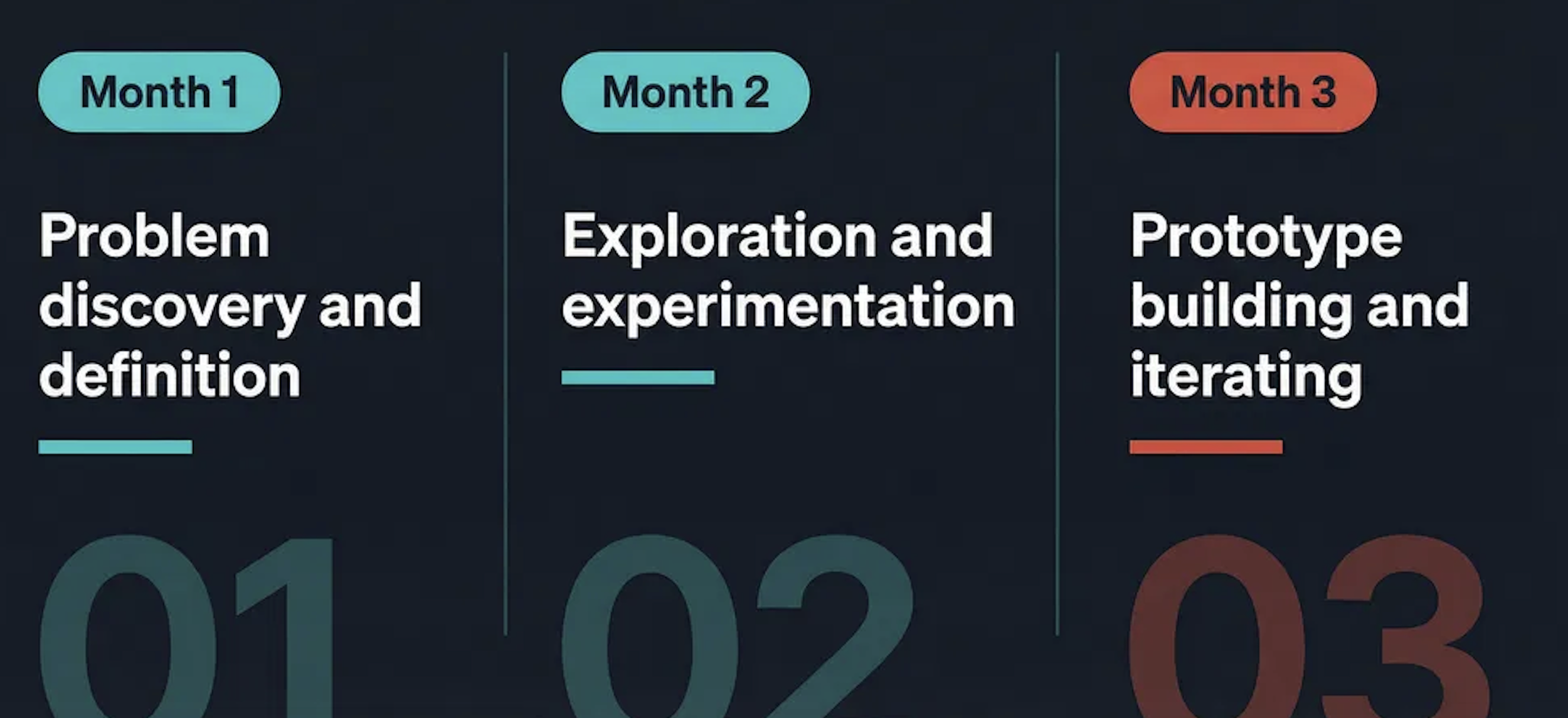
Starting in April, you will spend 13 weeks moving from curiosity to contribution. The cycle opens with a community kickoff. Through May and June, your Pod digs in, experimenting with approaches and building toward a solution. In July, you present your work at a public Showcase and summit.
Month 1 - Problem Discovery and Definition:
The cycle opens with a community Kickoff and Summit. Participants explore pressing challenges in the cycle's focus area and submit problem statements they want to tackle. Voting happens in two rounds, and working groups called pods form around the top ideas.
Month 2 - Exploration and Experimentation:
Pods meet their teams and begin experimenting with approaches, tools, and frameworks. Each pod can propose multiple solutions. Pods present their solutions to the cohort and mentors, who help validate focus and sharpen scope before building begins.
Month 3 - Prototype Building and Iterating:
With a clear direction set, projects start to build out their solution. Building is never linear. Teams iterate, get mentor feedback, and push their solutions further. The cycle concludes with a showcase where teams present their prototypes to the public.
Throughout the Build Cycle, participants take part in hands-on workshops designed to build the skills they need at each stage of their project.
FAQs
-
Upskilling Labs is open to anyone in the community interested in learning how to use AI tools to solve real problems. No prior technical experience is required. Curiosity and commitment are what matter.
-
A problem statement is a brief description of a challenge you think is worth solving. It does not need to be polished, just clear enough for others to understand what the issue is and why it matters.
-
Voting happens in two rounds. In the first round, participants who submitted a problem statement each get three votes to cast across the submissions they find most compelling. Any problem that receives at least 5 votes advances to the second round.
Next, voting opens to the full cohort and every participant gets three votes. Problems that receive at least 5 votes in this round are confirmed and move forward into Pod formation. -
A Pod is a small teams of 5 to 15 participants who work on a problem statement. Pods may come up multiple projects that they want to work on. Each project team can have between 3-7 members.
-
No. You can join the cycle by joining a pod even if you did not submit a problem statement yourself.
-
The Showcase is a public event at the end of the cycle where each pod presents their prototype. It is also when the next cycle is announced and a new round of problem submissions opens.
-
The Build Cycle runs for 13 weeks with meetups help every month. Participants should expect to invest a few hours per week.
Join Us
Most professionals learning AI are watching tutorials and collecting certificates. This cycle is different.
You will join a team, tackle a real energy or climate challenge, and walk away with a working solution and the credibility that comes from having built something real.